Ask anyone to picture a great interlocking driveway and they'll describe the border without realizing it: the charcoal band framing a cream field, the crisp line where the pavers meet the lawn, the apron that marks the garage. Borders and banding are a modest slice of a driveway budget, and they do a disproportionate share of the design work — while quietly performing a structural job, too, as the edge the restraint system locks against. This guide covers the border styles that work in the GTA, how to choose contrast colours that suit your house, banding ideas for large surfaces, and the design mistakes that make expensive driveways look cheaper than they were.
Quick answer — the border decisions that matter
Four decisions define a border scheme, in this order:
- Single or double row. A single soldier course frames quietly; a double band makes the border a design feature. Most contemporary GTA builds go double.
- The contrast colour. Darker than the field in most cases, and ideally repeating a colour already on the house — trim, roof, stone, garage door.
- Border only, or banding too. On driveways beyond a single-car width, inlay bands breaking the field into panels keep scale under control.
- Carried through, or driveway-only. The strongest frontages run the same border logic across driveway, walkway, and steps — one system, not three projects.
Border styles — soldier, sailor, single & double band
Soldier course
A single row of rectangular pavers set perpendicular to the edge — upright, uniform, standing at attention. The classic. On traditional homes in a matching tone it finishes the surface without announcing itself; in a contrasting tone it becomes a pinstripe.
Sailor course
The same row laid lengthwise along the edge. It reads calmer and more linear than a soldier course and suits modern architecture, especially with large-format fields where an upright soldier row would look busy against big units.
Single contrast band
One row in a contrasting colour — the minimum viable statement. It defines the surface from the street at very little added cost, and it's often the right restraint on smaller frontages where a double band would dominate.
Double band
Two contrasting rows — the signature GTA look. It frames confidently, visually contains large or busy fields, and photographs the way homeowners hope their driveway will. If you've admired a driveway in Mississauga or Vaughan in the last five years, odds are it wore one.
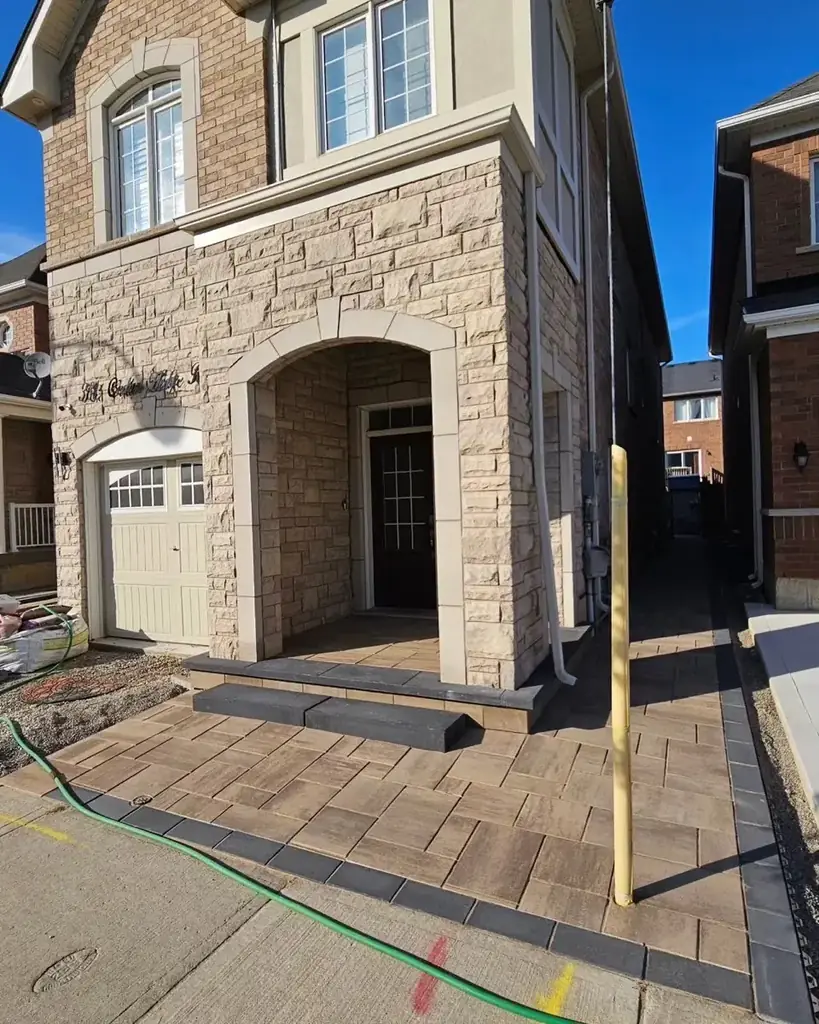
Colour strategy — choosing the contrast
The border colour decision is really a house question. The combinations that consistently work:
- Charcoal on cream or greige — the modern default. Crisp, forgiving of edge staining, at home against most brick and stone.
- Black on grey — sharper and more contemporary; suits new builds with dark trim and windows.
- Deep brown or terracotta on tan — the warm version, right beside older red-brick architecture where cool greys can feel imported.
- Tone-on-tone — a border one shade darker than the field. The quiet luxury option: you see the line, not the stripe.
Two practical rules. First, pull the colour from the house — a border that repeats the roof, trim, or garage-door tone ties the driveway into the architecture; a colour that exists nowhere else on the property looks applied. Second, go darker at the edges unless you have a specific contemporary reason not to: edges collect tire marks, soil, and snow-pile residue, and dark borders wear that invisibly.
Banding — design inside the field
Perimeter borders frame; banding composes. On any driveway wider than a single car, contrast strips through the field control the scale — and they're the detail that separates "a lot of pavers" from "a designed entrance."
- Panel bands divide a wide field into bays, often aligned with garage doors — the most common move on double and triple frontages.
- Apron bands mark the transition at the garage or the street with a full-width stripe — a threshold the eye reads instantly.
- Perimeter-echo bands run a second border inset from the first, creating a wide frame — the formal, estate-scale version.
- Curve-tracing bands follow a curved edge or walkway sweep, which is the single most effective way to make a curve look intentional.
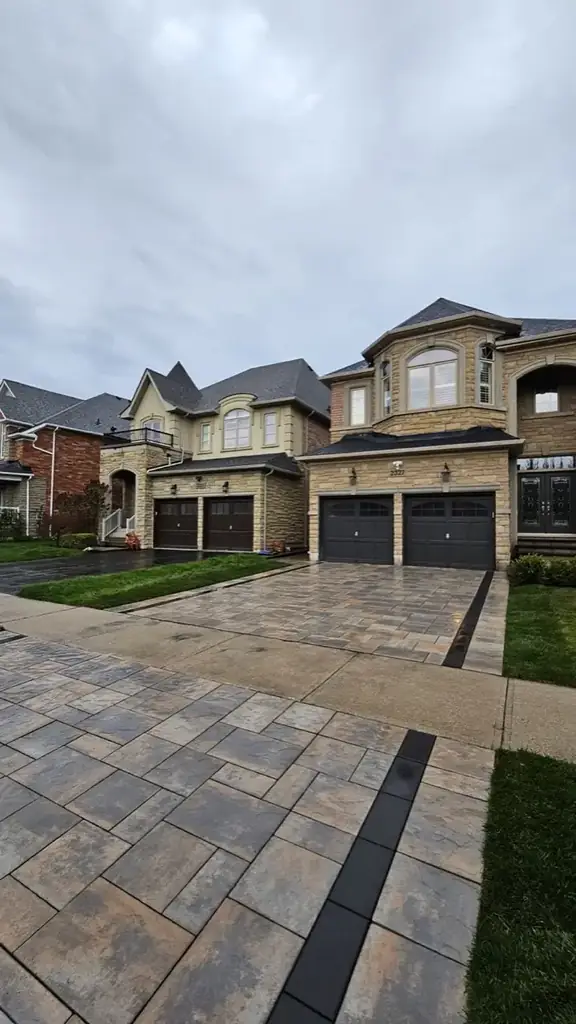
Aprons, curves & transitions
The apron
The first metre of driveway at the garage — and at the street — takes the most visual and physical traffic. A banded apron defines both thresholds, and at the street edge it gives the eye a clean terminus where driveway meets municipal curb or sidewalk.
Curves
Curved edges without a border look unfinished, because the field pattern ends in a ragged cut line. A border row swept along the curve gives it a drawn edge — and pairs best with a modular random field, which absorbs curved geometry without visible compromise. (For the field-pattern side of that decision, see our patterns guide.)
Transitions to walkway and steps
Where the driveway meets the front walkway and steps, the border is the connective tissue: the same band colour carried through walkway edges and step faces makes three surfaces read as one entrance. It costs nearly nothing at design time and is the single most repeated compliment our finished frontages get.
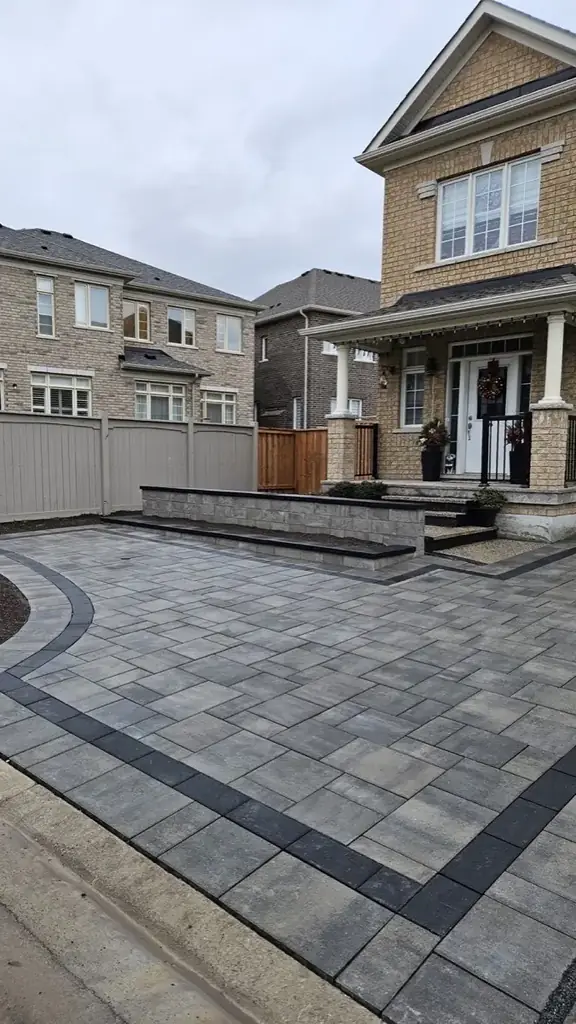
The structural job — borders and edge restraint
Beneath the design conversation, the perimeter has a job: an interlocking field stays tight only if its edges can't move. The working system is mechanical edge restraint — rigid edging anchored into the base below grade around the entire perimeter — and the border course is what it braces. A well-set border row over proper restraint is why a twenty-year-old driveway still has straight edges; a border over failed or missing restraint spreads with the rest of the field, which is a common finding when we repair older surfaces.
The takeaway for comparing quotes: ask what edge restraint is specified, not just what border is drawn. The visible row is the easy part.
Material pairings that work
Borders don't have to match the field product — some of the best schemes deliberately don't:
- Same product, contrast colour — the default, and the safest: identical texture and height, colour doing the work.
- Smooth border on textured field — a smooth charcoal band around a tumbled or embossed field adds a texture contrast that reads premium up close.
- Natural stone accents — a granite or limestone border around a concrete-paver field borrows the premium material where it's most visible. The reverse — premium field, budget border — always looks like what it is.
- Large-format field, standard-format border — the size step-down frames big slabs the way a mat frames a print.
What borders add to the budget
Less than their visual impact suggests. A border adds a second product, extra cutting, and layout care; banding adds more, since every inlay strip interrupts the field on both sides. But all of it moves a quote within the established GTA range — installed interlocking driveways run $15–$45+ per square foot all-in — rather than beyond it. On most projects the border scheme is single-digit percentage money doing front-page design work, which is why we almost never build without one. Full driveway pricing is in our driveway cost guide.
Border mistakes that cheapen good driveways
Mistake 1: No border at all
A field that dies into the lawn at a cut line looks unfinished at any budget. Even a tone-on-tone soldier course fixes it.
Mistake 2: A colour from nowhere
A red band on a grey-and-white house, a cool charcoal against warm 1970s brick — if the colour doesn't exist on the property, the border looks applied rather than designed.
Mistake 3: Border logic that stops at the driveway
A banded driveway beside an unbordered walkway reads as two eras of work. Carry the scheme through, or plan to.
Mistake 4: Over-banding small surfaces
Double bands, inlays, and an apron stripe on a single-car driveway is a lot of frame for a small picture. Small surfaces want one quiet border.
Mistake 5: Design row, no restraint
The border everyone sees fails without the restraint nobody does. If a quote specifies the band but not the edging system beneath it, ask the question.
FAQs about driveway borders & banding
What is a soldier course on an interlocking driveway?
A soldier course is a single row of rectangular pavers set perpendicular to the edge of the surface, standing at attention around the field — hence the name. It's the simplest border there is, and it does two jobs at once: it gives the driveway a crisp, finished frame, and it creates the straight, stable edge line that the mechanical edge restraint anchors against. A sailor course is the same idea with the pavers run lengthwise along the edge instead.
What's the most popular border style for GTA driveways right now?
The double band: two contrasting rows — almost always charcoal or black around a cream, grey, or greige field. It's become the signature GTA look of the last decade because it works on nearly every house: it sharpens the driveway's geometry from the street, visually contains large fields, and pairs with both traditional and contemporary architecture. Most of our own installations carry some version of it.
Does a border make an interlocking driveway more expensive?
Modestly. A border adds a second paver product, some additional cutting, and careful layout work — but it's a small share of a driveway budget, and it does double duty as the edge the restraint system locks against. Installed GTA driveways run $15–$45+ per square foot all-in, and border choice moves a quote within that range, not beyond it. Inlay banding through the field adds more labour than a perimeter border, since every band interrupts the field pattern on both sides.
Should the border be darker or lighter than the field?
Darker, in most cases. A darker border — charcoal around cream or grey — grounds the surface visually and hides the staining that edges collect from tires, soil, and snow piles. Light borders around dark fields can look striking on contemporary builds, but they show wear faster. The safest test: the border should repeat a colour that already exists on the house — trim, roof, stone, or garage door — so the driveway reads as part of the architecture.
What is banding on a driveway?
Banding is contrast strips run through the field itself rather than just around it — breaking a large driveway into visual panels, marking the apron at the garage, or tracing a curve. On big surfaces it's the difference between an expanse of pavers and a designed entrance. Bands are usually the same product as the border so the whole composition reads as one system.
Do borders work on curved driveways and walkways?
Yes — curves are where borders earn their keep. A border row follows the curve and gives the eye a clean line to read, while the field (ideally a modular random layout, which absorbs curves gracefully) fills behind it. The cutting is more demanding on curves, which is where installer skill shows: a curve with consistent joint lines and a smooth border sweep is hard to fake.
Can a border be added to an existing interlocking driveway?
Sometimes, and it depends on the edges. If the existing field is sound and the perimeter is accessible, the outer courses can be cut back and a contrasting border set in — often done during a re-level or restoration visit, when the edges are already open. If the driveway's edge restraint has failed or the perimeter has spread, the border project becomes an edge repair project first, which is the better order anyway.
What's the difference between a border and edge restraint?
The border is the visible design row; the edge restraint is the hidden structural system — an anchored rigid edging installed against the base below grade, which stops the entire field from spreading under load. They work together: the restraint holds the border, the border locks the field. A driveway can have a beautiful border and failed restraint, and it will still spread. When you're comparing quotes, 'what edge restraint do you install?' tells you more than any border swatch.