Pick up any paver catalogue and you'll find a dozen named patterns; walk any GTA street and you'll see the three that actually matter: herringbone, running bond, and modular random (often called ashlar). The pattern you choose changes how strong the surface is under vehicle loads, how much cutting the installation needs, how the finished project suits your home's architecture — and, more than most homeowners expect, how the whole property reads from the street. This guide covers the real differences, with photos from our own GTA installations, plus the border and banding decisions that do as much for the final look as the field pattern itself.
Quick answer — which pattern for which project
- Driveway with daily vehicle traffic: 45° herringbone for maximum interlock, 90° herringbone for nearly the same strength with less cutting waste — or a driveway-rated large-format random laid over a proper base, which is what most contemporary GTA builds choose.
- Front walkway or patio: any of the three works structurally; choose by the house. Running bond for clean modern lines, herringbone for traditional brick character, modular random for the natural-stone look.
- Small or narrow spaces: smaller formats, simpler patterns. Save the drama for the border.
- Large open surfaces: large-format random with contrast banding — confident scale, no parking-lot monotony.
And the rule that outranks all of the above: the base decides whether any pattern survives. A herringbone field on three inches of base fails exactly as fast as a stack-bond one. Pattern is a design and load-distribution decision; longevity is decided underground, the same way it is for every driveway, patio, and walkway we build.
Herringbone — the structural workhorse
Herringbone sets rectangular pavers in an interlocking zigzag, at either 45 or 90 degrees to the surface's main direction. It's the oldest pattern in the book — Roman roads used it — and it's survived because of what it does under load: every paver is locked against its neighbours in two directions, so the forces from braking, turning, and acceleration spread across the field instead of pushing rows apart.
45° vs 90°
45-degree herringbone is the strongest layout you can buy and the most labour-intensive: every edge of the field ends in a diagonal cut, which means more saw time and more waste. 90-degree herringbone gives up a small amount of interlock in exchange for straight edge cuts and noticeably less waste — a sensible trade on most residential driveways.
Where it shines
Driveways above all — especially sloped driveways, where surfaces fight gravity as well as tires. Visually, herringbone suits traditional and heritage homes: on the brick streets of older Toronto neighbourhoods, a tumbled-paver herringbone drive looks like it came with the house.
Running bond — the quiet classic
Running bond lays pavers in offset rows — classic brickwork, moved to the ground. It installs quickly, wastes very little material, and reads calm and linear in a way that suits mid-century and modern architecture. Laid perpendicular to the direction of travel, it's structurally adequate for residential driveways; laid parallel, it's better reserved for walkways and patios, since wheel loads can work parallel joint lines open over time.
Two variations worth knowing: stack bond (no offset, pure grid) is the weakest layout mechanically and belongs only on foot-traffic surfaces where its strict modern grid is the whole point; and basketweave trades the offset rows for paired pavers in alternating orientation — a traditional look that behaves like running bond structurally.
Modular random (ashlar) — the GTA's favourite
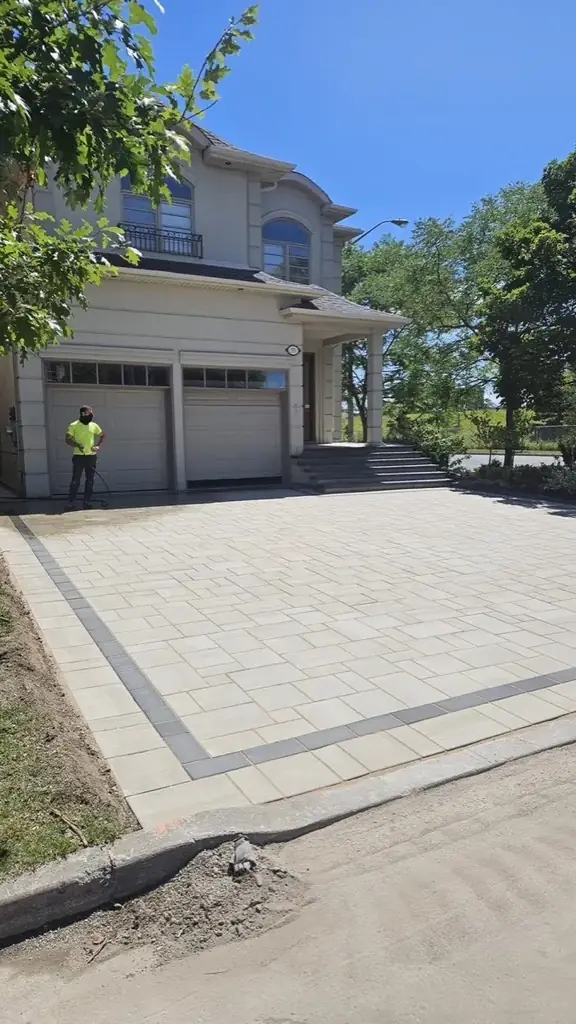
Walk any street built or renovated in the GTA in the last decade and this is the pattern you're looking at: two to four paver sizes mixed in a layout with no repeating rows. It hides the grid entirely, reads closer to natural stone than to brick, and suits everything from a 1950s ranch to a brand-new contemporary build — which is exactly why most large-format product lines are engineered for it, and why most of our own installations land on it.
It has two quiet practical advantages. First, repairs disappear: with no pattern line to interrupt, a properly relaid area is undetectable. Second, it tolerates imperfect field dimensions gracefully — where a herringbone field wants exact geometry, a random layout absorbs the quirks of real lots and curved borders without visible compromise.
Side-by-side comparison
| Pattern | Vehicle strength | Cutting waste | Visual character | Best for |
|---|---|---|---|---|
| Herringbone 45° | Strongest | Highest | Traditional, busy, directional | Driveways, slopes, heritage homes |
| Herringbone 90° | Near-strongest | Moderate | Traditional, slightly calmer | Driveways with budget discipline |
| Running bond | Good (perpendicular to traffic) | Lowest | Clean, linear, quiet | Walkways, patios, modern homes |
| Basketweave | Good | Low | Traditional, textured | Patios, heritage walkways |
| Stack bond | Weakest | Lowest | Strict modern grid | Patios and paths only |
| Modular random (ashlar) | Very good (driveway-rated units) | Low–moderate | Natural, grid-free, versatile | Almost everything — the GTA default |
Borders, soldier courses & banding
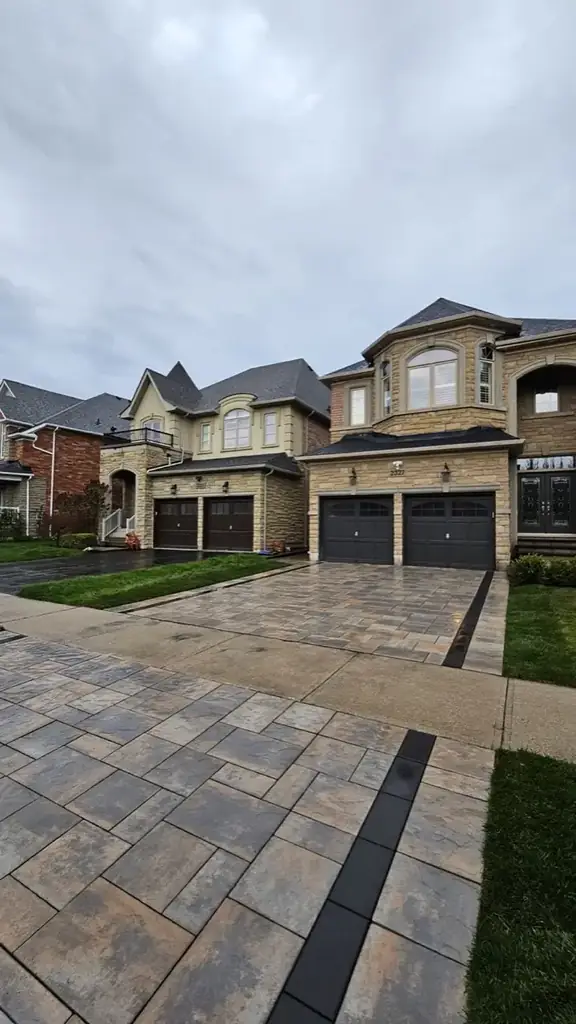
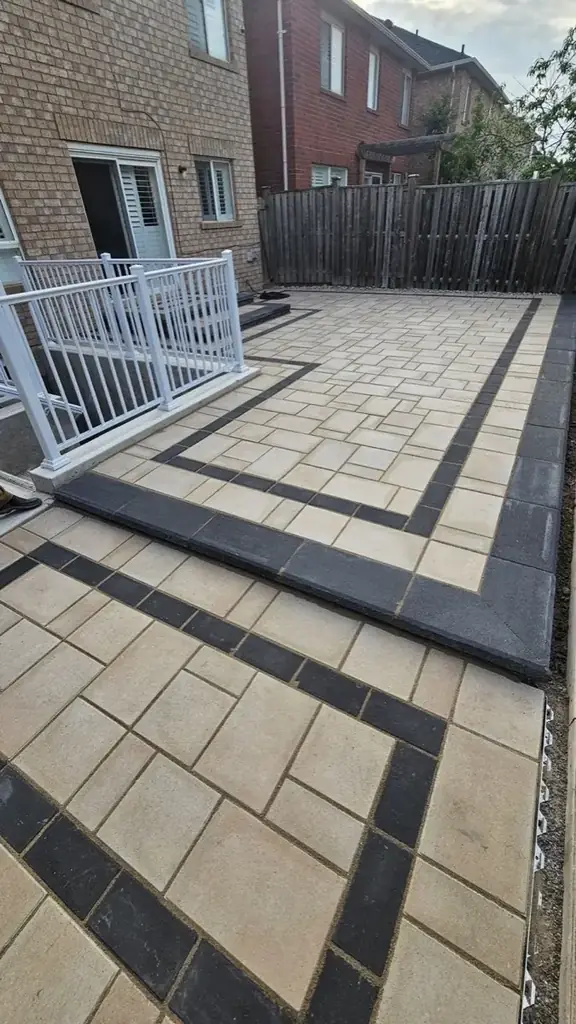
Here's the part catalogues undersell: on most finished projects, the border does more for the look than the field pattern. A soldier course (a single row of pavers set perpendicular to the edge) crisply frames any field. A double band in a contrasting colour — charcoal around cream, black around grey — is the signature GTA look of the last decade, and it earns its popularity: it defines the surface from the street, visually contains a busy field, and marks the edge that the mechanical restraint is holding underneath.
Inlay banding takes it further — contrast strips running through the field itself, breaking a large driveway into visual panels. On big surfaces this is the difference between "expanse of pavers" and "designed entrance."
How to choose — architecture, scale & traffic
Start with the house
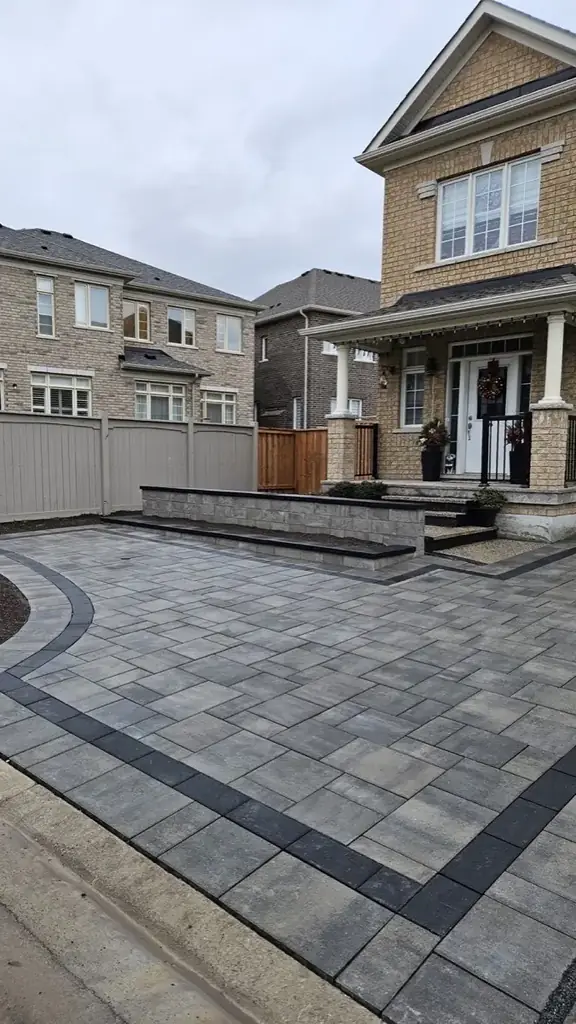
Brick and heritage architecture carries herringbone and basketweave naturally. Mid-century and contemporary homes want running bond's clean lines or a large-format random. Stone-clad and transitional houses pair best with ashlar layouts that echo the masonry. When in doubt, hold samples against the house — the pattern decision is really a conversation between the field and the facade.
Then the scale
Large surfaces take large formats and confident banding; small spaces want smaller units and simpler layouts. The most common design miss we correct at the quoting stage is scale mismatch in both directions — postage-stamp pavers lost on a triple-wide driveway, or 24-inch slabs crowding a 40-inch walkway.
Then the traffic
Daily vehicle loads push you toward herringbone or a driveway-rated random; foot traffic frees you to choose on looks alone. Slopes tighten the rules further — that's herringbone territory.
Does pattern change the price?
Modestly. Pattern affects labour and cutting waste — a 45° herringbone edge is all diagonal cuts, a running bond edge is nearly none — but the dominant price levers remain the paver product and the base work. For context, installed interlocking in the GTA runs $15–$45+ per square foot for driveways and $18–$60+ for patios, ranges set mostly by material grade and site conditions; pattern choice moves a quote within those ranges, not between them. The full numbers are in our driveway and patio cost guides.
One honest budgeting note: if you're choosing between a premium pattern in a basic paver and a basic pattern in a premium paver, take the premium paver. Pattern is geometry; the material is what you see, touch, and weather for thirty years.
Pattern mistakes we see most
Mistake 1: Stack bond on a driveway
The strict grid looks sharp on a rendering and opens up under real wheel loads. Grids are for patios.
Mistake 2: Pattern chosen before width and layout
Get the surface's dimensions and borders right first; the field pattern is the last major decision, not the first.
Mistake 3: Three patterns on one project
Field, border, accent — one of each, maximum. Beyond that, the design stops being a design.
Mistake 4: Ignoring the laying direction
Running bond parallel to traffic, herringbone oriented without regard to the slope — direction is part of the pattern's engineering, not a styling afterthought.
Mistake 5: Catalogue-first thinking
The pattern that looked perfect on a showroom board can look wrong against your brick. Samples on-site, against the house, in daylight — that's where this decision should be made.
FAQs about interlocking patterns
What is the strongest interlocking pattern for a driveway?
Herringbone — specifically 45-degree herringbone. The zigzag geometry locks each paver against its neighbours in two directions, so braking and turning forces spread across the field instead of pushing rows apart. It's why herringbone has been the default recommendation for vehicle surfaces for decades. 90-degree herringbone is nearly as strong and wastes fewer cuts; running bond is adequate for driveways when it runs perpendicular to traffic; stack bond is the weakest and belongs on patios, not driveways.
What's the difference between running bond and herringbone?
Running bond lays pavers in offset rows, like classic brickwork — fast to install, calm to look at, and economical because it generates few cuts. Herringbone sets pavers in an interlocking zigzag at 45 or 90 degrees, which takes more cuts and labour but creates the strongest mechanical interlock of any pattern. Visually, running bond reads quiet and linear; herringbone reads busy and traditional. Structurally, herringbone wins; for foot-traffic surfaces, the difference rarely matters.
What is a random or ashlar interlocking pattern?
A modular random (ashlar) pattern mixes two to four paver sizes in a layout with no repeating rows — the look of the cream and grey driveways you see across the newer GTA neighbourhoods. It hides the grid, suits both traditional and contemporary homes, and disguises future repairs well because there's no pattern line to interrupt. Most large-format product lines are designed for it, and it's what the majority of our own GTA installations land on.
Does the pattern change the price of an interlocking project?
Somewhat — through labour and cutting waste, not materials. A 45-degree herringbone generates diagonal cuts along every edge; a running bond or random layout wastes far less. The bigger price lever is always the paver product itself and the base preparation: installed interlocking in the GTA runs $15–$45+ per square foot for driveways and $18–$60+ for patios depending mostly on material grade and site conditions, with pattern choice moving the number only modestly within those ranges.
Do I need a border or soldier course with my pattern?
On almost every project, yes — and not just for looks. The border (a soldier course or double band, usually in a contrasting colour) frames the field visually, but it also works with the edge restraint to lock the perimeter. A charcoal band around a cream field is the signature look across the GTA right now for good reason: it sharpens the design and defines the edge that keeps the field tight.
Which interlocking pattern is best for a small space?
Scale the pattern to the space. Small yards and narrow walkways read best with smaller-format pavers in a simple running bond or a tight modular random — oversized slabs can make a compact area feel smaller, and a busy 45-degree herringbone can overwhelm it. On a large driveway the logic flips: large-format units and confident banding keep a big field from looking like a parking lot.
Can different patterns be combined on one project?
Yes, and the best designs usually do: a random-laid field with a double-band border, a herringbone driveway with a soldier course, or a contrasting inlay strip breaking up a large surface. The rule that keeps combinations elegant is hierarchy — one field pattern, one border logic, at most one accent. Three patterns fighting for attention is how a driveway ends up looking like a paver catalogue.
Does the pattern affect how repairs look later?
A little. Random/ashlar layouts hide repairs best — with no repeating line, a relaid area disappears completely. Herringbone and running bond repairs are also invisible when done properly (the same stones go back in the same pattern), but sloppy relays show faster because any drift breaks the visible line. Either way, a proper repair reuses your original pavers, which is what really makes the fix disappear.